
Learn how to validate UX assumptions before you build. Avoid costly mistakes with a proven 6-step framework, real examples, and quick validation methods.
Learn how to validate UX assumptions before you build. Avoid costly mistakes with a proven 6-step framework, real examples, and quick validation methods.
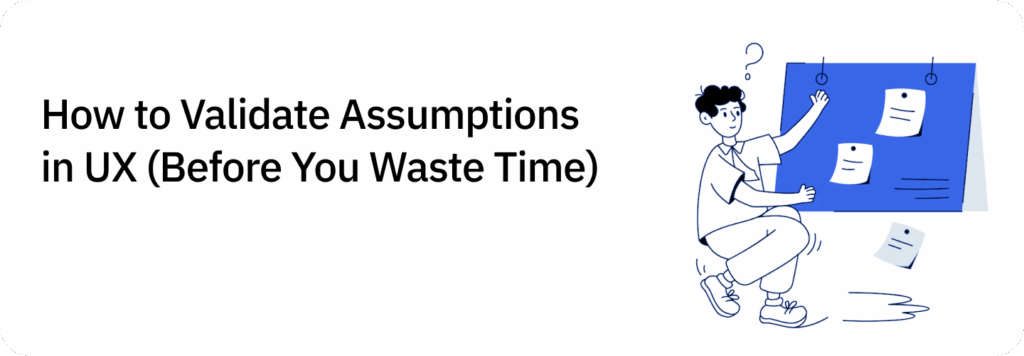
A team designed a collaborative whiteboard feature. Their assumption: “Remote teams need better brainstorming tools.”
Six months of development. $240,000 invested. Launch day: 6% adoption.
Why? They never validated the assumption. Turns out remote teams weren’t struggling with brainstorming. They were struggling with decision documentation after brainstorming. They had plenty of tools for generating ideas. They needed tools for tracking decisions and action items.
Every design decision rests on assumptions. About users, problems, solutions, priorities, and contexts. When assumptions are wrong, everything built on them fails. No matter how beautiful the design or solid engineering.
The cruel truth: validating assumptions in UX takes 1-2 weeks and costs $5,000-15,000. Building on wrong assumptions takes 3-6 months and costs $100,000-500,000.
This guide shows you exactly how to validate assumptions in UX before you waste time, money, and team morale building the wrong thing.
UX assumptions are beliefs you hold about users, problems, or solutions that you treat as facts without validation.
Common assumption patterns:
About users:
About problems:
About solutions:
Assumptions feel like knowledge:
But assumptions are guesses disguised as facts:
Real example: Healthcare app assumed doctors wanted comprehensive patient data on mobile. Validation revealed doctors wanted mobile for quick reference only, used desktop for comprehensive review. Mobile app design was completely wrong. $180K wasted before validation happened.
Understanding assumption validation in UX design means treating beliefs as hypotheses to test, not truths to build on.
Not all assumptions are equally risky. Prioritize validation based on risk level.
What you assume: Who your users are, what roles they have, what contexts they work in
Why this is high risk: If you’re wrong about WHO you’re designing for, everything else fails.
How to validate:
Validation questions:
What you assume: What problems users experience, why problems exist, how severe problems are
Why this is high risk: Building solutions to problems that don’t exist guarantees failure.
How to validate:
Validation questions:
For systematic approaches to problem validation, read our guide on problem framing in UX that ensures you’re solving real problems.
What you assume: That your proposed solution will solve the problem, that users will adopt it
How to validate:
Validation questions:
What you assume: How users currently behave, what they do, how they accomplish tasks
How to validate:
Validation questions:
Understanding UX assumption testing methods includes distinguishing between what users say they do and what they actually do. Observation beats interviews for behavioral validation.
What you assume: Where, when, and under what conditions users interact with your product
How to validate:
Validation questions:
Here’s the systematic process for validating UX assumptions before design begins.
What to do: Before any research or design, write down every assumption you’re making.
Template:
ASSUMPTION: [What you believe to be true]
RISK LEVEL: [High/Medium/Low]
IF WRONG: [What fails if this assumption is false?]
HOW TO TEST: [Method for validation]
Goal: Document 15-25 assumptions across all categories
Time investment: 2-3 hours
What to do: Not all assumptions need equal validation. Focus on highest-risk first.
High risk = Validate first:
Focus validation on top 5-8 high-risk assumptions.
Understanding how to test UX assumptions efficiently means knowing which assumptions deserve validation time and which can be accepted with reasonable confidence.
For User Identity Assumptions:
For Problem Assumptions:
For Solution Assumptions:
For Behavioral Assumptions:
For comprehensive method selection, see our guide on UX research methodologies explained with validation-specific techniques.
The key principle: Look for disconfirming evidence, not confirming evidence.
Bad validation test: “Would customizable dashboards be helpful to you?”
Good validation test: “Show me your current dashboard tools. Which have you customized? Why?”
Validation test design principles:
Research execution tips:
Create psychologically safe environment:
Watch behavior, not just words:
Sample size guidance:
Understanding UX research validation techniques means knowing when you have enough evidence to make confident decisions versus when you need more data.
Three possible outcomes:
Share with stakeholders BEFORE design begins to align on validated understanding.
For guidance on presenting findings that challenge assumptions, see our guide on getting stakeholder buy-in for UX research even when validation contradicts plans.
Assumption: “Enterprise users need highly customizable workflows”
Validation findings:
Impact:
Time invested in validation: 2 weeks, $8K Waste avoided: $150K + 4 months
Assumption: “Users primarily work on mobile devices”
Validation findings:
Impact:
Time invested in validation: 1 week, $5K Waste avoided: $85K + 6 weeks
Hour 1-2: Map assumptions
Hour 3-5: Rapid research
Hour 6-7: Analytics review
Hour 8: Synthesis
Output: Validated direction for 5 critical assumptions
Understanding quick UX validation methods means having techniques for time-constrained situations while recognizing their limitations.
Leading: “Wouldn’t customizable dashboards make your work easier?”
Neutral: “Show me your current dashboard. What would you change if you could?”
Wrong: Looking for evidence assumptions are correct
Right: Looking for evidence assumptions are wrong
For systematic approaches to avoiding these mistakes, read our guide on how to conduct user interviews that uncover real insights without bias.
The math is simple:
Validation investment:
Building on wrong assumptions:
ROI of assumption validation: 10-30x return
The pattern across hundreds of projects:
Projects that validate assumptions:
Projects that skip validation:
Validating assumptions in UX isn’t optional research. It’s insurance against catastrophic waste.
Every design decision rests on assumptions. The only question is: will you test those assumptions before or after you waste time building the wrong thing?
Stop assuming. Start validating.
Continue Learning:
Start this week: List 10 assumptions about your current project. Identify the 3 riskiest. Spend 2 days validating them before designing anything.
Tool and strategies modern teams need to help their companies grow.
Learn how to validate UX assumptions before you build. Avoid costly mistakes with a proven 6-step framework, real examples, and quick validation methods.
Learn how to frame UX problems the right way. Transform vague stakeholder requests into validated problem statements that lead to better design outcomes.

Think your UX research is working? These 7 warning signs reveal when surface-level research is creating false confidence — and leading your team in the wrong direction.
Discover the 8 most common UX discovery mistakes that lead to product failure — and the practical checklist that helps teams avoid them before building anything.

Surface requests hide real problems. Learn 5 proven discovery techniques — including JTBD interviews and contextual observation — to uncover what users actually need.

No users, no time, no budget? Learn practical solutions to the most common UX research challenges — so constraints stop being excuses and research actually happens.

Stop guessing at UX research ROI. These 3 real case studies show returns of 1,360%–4,783% — with payback periods as short as 7 days. Here's how the math works.
Still hearing "we can't afford research"? Learn how to reframe the conversation, handle common objections, and get UX research budget approved with proven ROI data.
Real design starts before you open Figma. Learn the 4-phase UX discovery process that separates products users love from solutions that look great but go unused.
UX research is the first thing cut when timelines tighten — and the most expensive mistake you can make. Here's why skipping it costs far more than doing it.

The complete guide to UX research and problem discovery — from stakeholder interviews to validated problem statements that lead to products users actually want.
Learn what usability testing is, why it matters, and how to run effective tests — including the most common mistakes that undermine results before you even start.
 Hanin Hany
Discover the Power of Design to Code Conversion
Take your design workflow to the next level with our revolutionary plugin that converts design to code.